
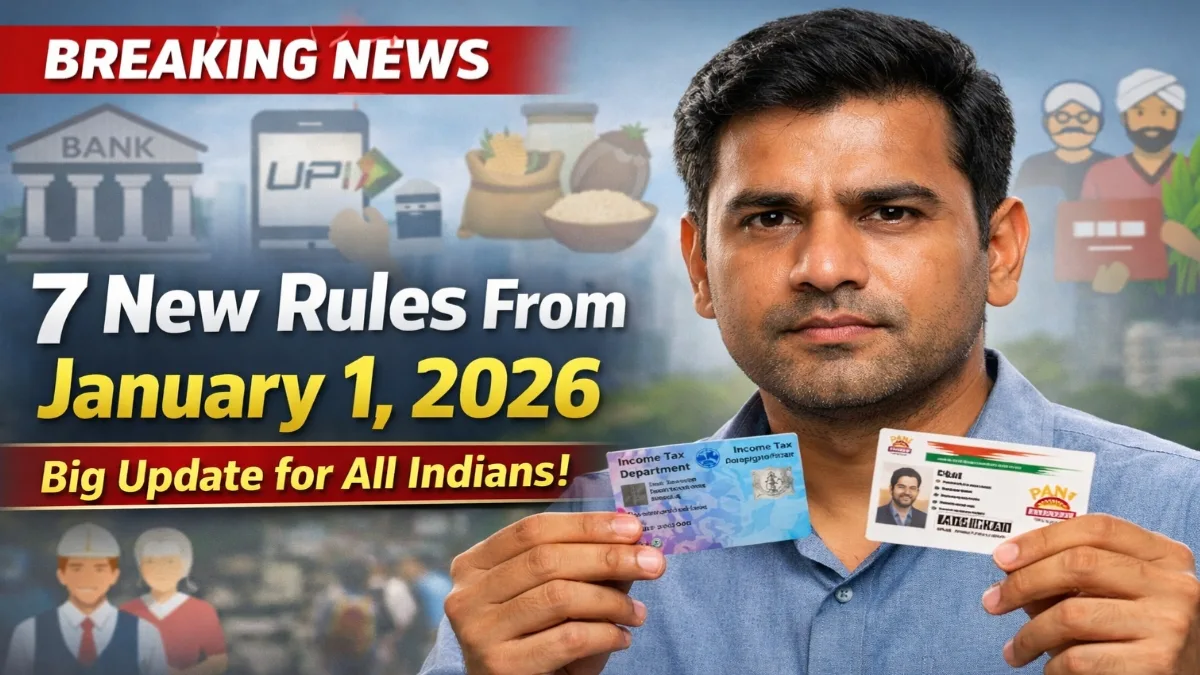
7 New Rules From 1st January 2026 in India: What Will Change for Common Citizens?
1. PAN–Aadhaar Linking Becomes Strictly Mandatory
One of the most important changes among the 7 New Rules From 1st January 2026 is the strict enforcement of PAN–Aadhaar linking. From January 2026 onwards, PAN cards that are not linked with Aadhaar may become inactive.
An inactive PAN can lead to multiple financial and legal problems, including:
- Inability to file income tax returns
- Higher Tax Deducted at Source (TDS)
- Problems in opening or operating bank accounts
- Issues with Demat accounts and investments
- Difficulty in availing government welfare schemes
To avoid these problems, citizens are strongly advised to complete PAN–Aadhaar linking well before 1st January 2026.
2. Banking and Digital Payment Rules Tightened
Another major highlight of the 7 New Rules From 1st January 2026 in India is the tightening of banking and digital payment regulations. With the rise in online fraud and cybercrime, banks and financial institutions will adopt stricter security measures.
Expected changes include:
- Stricter KYC verification for existing bank accounts
- Mandatory mobile number and SIM verification for UPI
- Enhanced monitoring of suspicious transactions
- Instant alerts for high-value digital payments
These measures aim to make online banking safer and protect customers from financial fraud. While this may require additional verification steps, it will significantly improve security.
3. Credit Score and Loan-Related Updates
As part of the 7 New Rules From 1st January 2026, credit score reporting systems are expected to become faster and more transparent. Instead of delayed updates, credit bureaus may refresh credit data weekly or in near real-time.
This change will benefit borrowers in many ways:
- Loan repayments will reflect faster in credit scores
- Improved transparency in financial records
- Quicker loan approvals
- Better chances of getting lower interest rates
However, missed EMIs or delayed payments will also impact credit scores more quickly. Therefore, financial discipline will become even more important in 2026.
4. Pension and Social Security Reforms
Pensioners will see positive changes under the 7 New Rules From 1st January 2026 in India. The government aims to make pension services more efficient, transparent, and pensioner-friendly.
Key reforms may include:
- Digital submission of life certificates
- Faster pension disbursement
- Reduced paperwork and physical verification
- Improved grievance redressal systems
These reforms will reduce the need for senior citizens to visit banks or government offices frequently, ensuring dignity and convenience.
5. Ration Card and Welfare Scheme Digitization
Digitization of welfare schemes is another major component of the 7 New Rules From 1st January 2026. Ration card services are expected to become more transparent and user-friendly.
Likely updates include:
- Online updating of address and family details
- Improved nationwide portability of ration cards
- Aadhaar-based verification to prevent duplication
These changes will ensure that subsidies reach genuine beneficiaries and reduce misuse of government resources.
6. Farmer and Agriculture Scheme Updates
Farmers will also be impacted by the 7 New Rules From 1st January 2026 in India. The government plans to strengthen digital verification for agriculture-related schemes.
Possible changes include:
- Mandatory Digital Farmer ID
- Integration of land records with government databases
- Faster disbursement of PM-Kisan benefits
- Better crop insurance claim processing
These steps aim to eliminate fake beneficiaries and ensure that financial assistance reaches genuine farmers on time.
7. Education and Youth-Focused Digital Rules
Education and youth-related reforms are also included in the 7 New Rules From 1st January 2026. Schools and colleges may adopt advanced digital systems for attendance, certification, and verification.
Additionally, stricter controls may be introduced to regulate underage access to digital platforms, promoting safer online behavior among students.
Why These 7 New Rules From 1st January 2026 Matter
These 7 New Rules From 1st January 2026 in India are not just policy changes on paper. They directly affect everyday activities such as banking, receiving pensions, applying for loans, accessing subsidies, and using digital services.
Preparing in advance will help citizens avoid service interruptions, penalties, and unnecessary stress.
Frequently Asked Questions (FAQ)
Q1. What is the most important rule among the 7 New Rules From 1st January 2026?
PAN–Aadhaar linking is considered the most critical rule as it impacts banking, taxation, and access to government benefits.
Q2. Will banking services stop if KYC is not updated?
Banks may restrict certain services until KYC requirements are completed.
Q3. How will credit score updates help borrowers?
Faster updates allow timely reflection of repayments, improving loan eligibility.
Q4. Are pensioners required to submit documents again?
Mostly digital verification will be used, reducing paperwork.
Q5. Do these rules apply to everyone?
Most citizens will be affected by at least one of the 7 New Rules From 1st January 2026.
Conclusion
The 7 New Rules From 1st January 2026 mark a major shift towards a digital, transparent, and citizen-friendly governance system. Staying informed and proactive is the best way to adapt smoothly.
Update your documents, follow official announcements, and take timely action to enjoy uninterrupted services throughout 2026.
Related:
Ration Card Big new Update

Indrajit Mandal
Digital Content Creator & Founder
Indrajit Mandal is a passionate blogger and the voice behind the YouTube channel
‘Mandal Seva Kendra’.
He covers a wide range of topics, including Government Schemes, Education, Finance, tech and Trending News, Global Trends News Update.
Dedicated to delivering accurate and real-time updates, he simplifies complex information for his readers.