
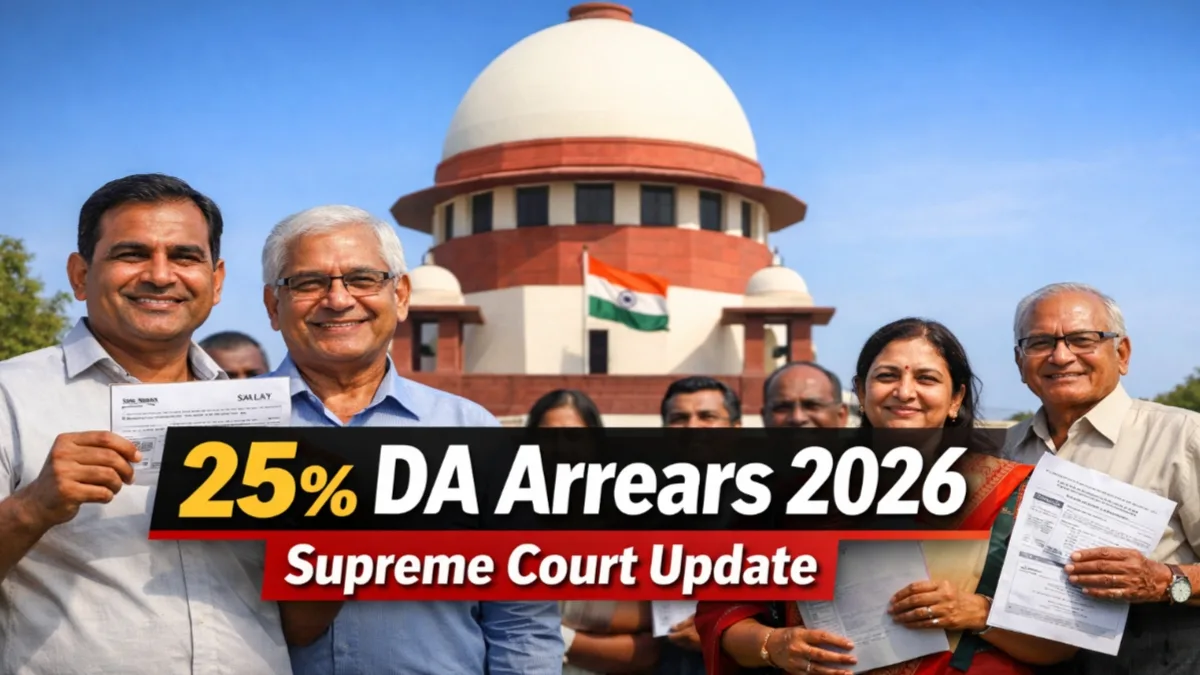
Supreme Court Decision 2026: 25% DA Arrears Relief Announced – Latest Update
What Is Dearness Allowance (DA)?
Dearness Allowance is a financial component paid to government employees and pensioners to offset the impact of rising inflation. The government revises DA periodically based on inflation levels so that salaries and pensions retain their real value.
While central government employees receive regular DA hikes, several state government employees, especially in West Bengal, have faced delays and lower DA rates for years. This imbalance led to widespread dissatisfaction and legal action.
Background of the DA Arrears Case
The DA arrears dispute began when West Bengal government employees demanded DA parity with central government employees. The matter reached the Calcutta High Court, which ruled in favor of employees and directed the state government to clear pending DA arrears.
The West Bengal government challenged this order in the Supreme Court, citing financial constraints. After multiple hearings, the Supreme Court issued an interim order in 2025 directing the state to pay 25% of the pending DA arrears.
Supreme Court Decision 2026: Current Status
As of 2026, the Supreme Court has not delivered its final judgment on the complete DA arrears issue. However, the interim order for 25% DA arrears relief remains valid and legally binding.
The Court has reserved its final verdict, which means arguments from both sides have been heard, and the judgment will be announced at a later date.
What Exactly Did the Supreme Court Order?
The Supreme Court directed the West Bengal government to:
- Pay 25% of the total pending DA arrears
- Provide this payment as interim relief
- Continue legal proceedings for final resolution
The Court clarified that this relief does not decide the final entitlement but offers immediate financial support to employees and pensioners.
Why Is the Final Verdict Delayed?
The delay is due to complex legal and constitutional questions. The Supreme Court is examining whether Dearness Allowance is a legal right of employees or a policy decision of the government.
The Court is also considering the financial position of state governments and the broader impact of such a ruling across India. These factors require careful legal balancing.
Who Will Benefit from the 25% DA Arrears Relief?
The 25% DA arrears relief applies to:
- West Bengal government employees
- State government pensioners
- Retired employees eligible for DA arrears
- Family pension beneficiaries
This relief offers partial financial support to lakhs of families who have waited for years for DA parity.
How Much Money Is Involved?
The total DA arrears liability runs into tens of thousands of crores of rupees. The 25% interim relief alone involves several thousand crores.
The actual amount each employee receives depends on their pay scale, length of service, and applicable DA rates during the arrears period.
Will Full DA Arrears Be Paid in 2026?
As of now, there is no official confirmation regarding full DA arrears payment. The final decision rests with the Supreme Court.
Possible outcomes include full payment, phased payment, or partial relief based on financial considerations.
Government’s Stand on DA Arrears
The West Bengal government has repeatedly stated that paying full DA arrears in one installment would create a heavy financial burden. The government argues that it must balance employee demands with development and welfare spending.
Employee unions, however, maintain that DA is essential for survival amid rising inflation and should not be delayed.
Impact on Other States
The Supreme Court’s final decision will likely set a precedent for other states facing similar DA disputes. Many state government employees across India are closely monitoring this case.
What Should Employees Do Now?
Employees and pensioners should stay informed through official notifications and court updates. They should avoid rumors and rely only on credible sources.
No separate application process has been announced so far for receiving DA arrears.
FAQs: Supreme Court Decision 2026 on 25% DA Arrears Relief
Is the 25% DA arrears order final?
No, it is an interim order. The final verdict is still pending.
Will employees receive 100% DA arrears?
The final decision has not yet been announced by the Supreme Court.
Are pensioners included in this relief?
Yes, pensioners and family pensioners are eligible.
Has payment started in 2026?
Implementation depends on further government and court directions.
Is this case applicable to all states?
The case directly applies to West Bengal, but its impact may influence other states.
Conclusion
The Supreme Court decision 2026 on 25% DA arrears relief remains a crucial development for government employees and pensioners. Although the final judgment is still awaited, the interim relief has provided hope and recognition of long-pending demands.
Employees should remain patient and vigilant as the final outcome will shape the future of Dearness Allowance policies across India.
Related:
DA Hike Latest Update

Indrajit Mandal
Digital Content Creator & Founder
Indrajit Mandal is a passionate blogger and the voice behind the YouTube channel
‘Mandal Seva Kendra’.
He covers a wide range of topics, including Government Schemes, Education, Finance, tech and Trending News, Global Trends News Update.
Dedicated to delivering accurate and real-time updates, he simplifies complex information for his readers.