
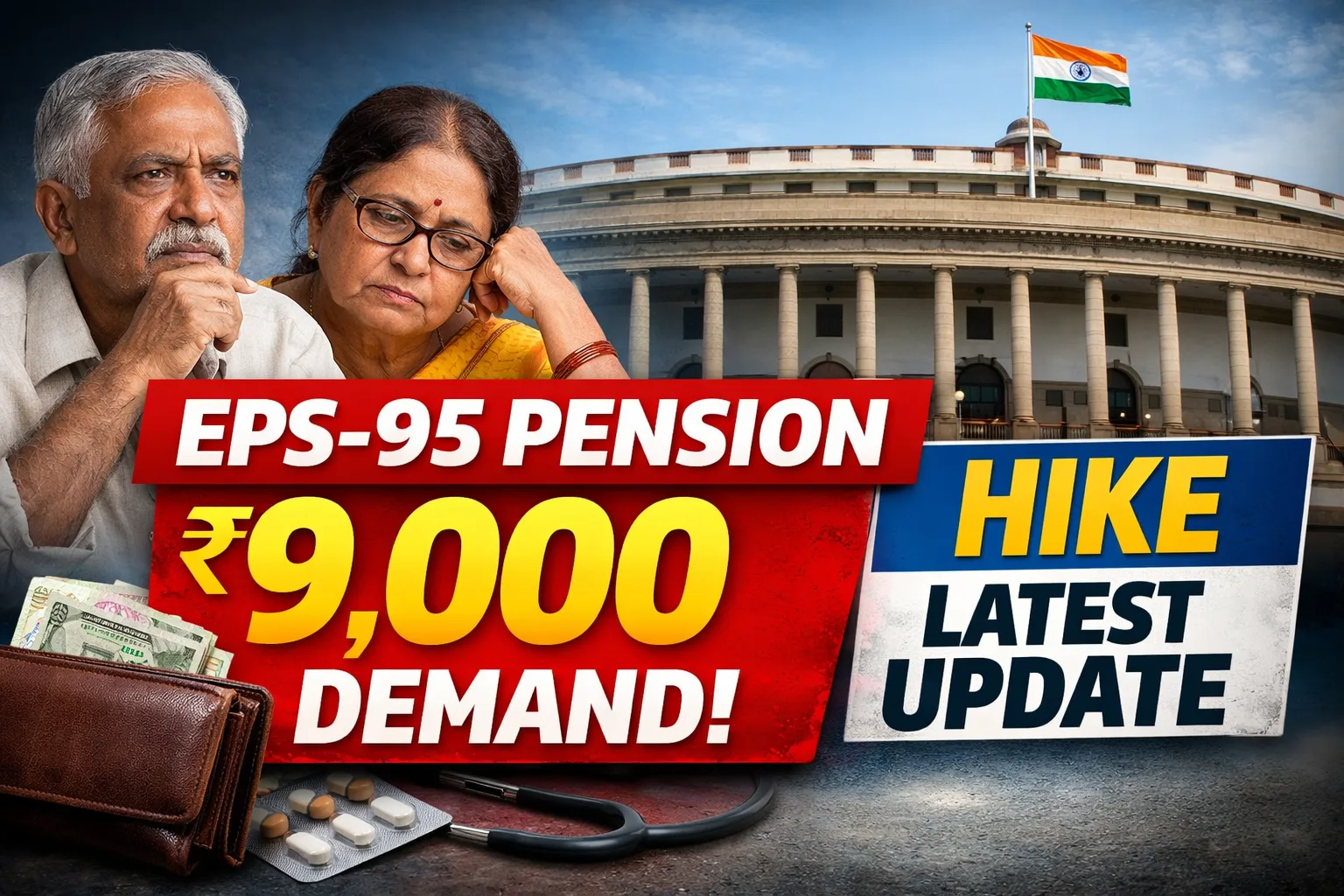
EPS-95 pension 9000 demand: Why Pensioners Are Asking for a Fair and Dignified Monthly Income
EPS-95 pension 9000 demand : The demand for EPS-95 pension ₹9,000 per month has once again brought national attention to the long‑standing struggles of retired private‑sector employees in India. With rising inflation, increasing medical expenses, and the absence of Dearness Allowance (DA), pensioners argue that the current ₹1,000 minimum pension is no longer livable.
Across the country, pensioners’ unions, former employees, and labour organisations are raising a clear and unified voice: a dignified life after retirement needs a dignified pension. This article explains the EPS-95 pension 9000 demand, the logic behind it, the government’s response, and the realistic chances of a future increase.
What Is EPS‑95 and Why Does It Matter?
The Employees’ Pension Scheme, 1995 (EPS‑95) operates under the Employees’ Provident Fund Organisation (EPFO). It provides monthly pensions to employees from the organised private sector after retirement.
Under this scheme:
- Employers contribute 8.33% of the employee’s basic salary (up to the wage ceiling) toward the pension fund.
- The Central Government contributes 1.16%, subject to limits.
- Pension amounts depend on years of service and pensionable salary.
Despite decades of service, a large number of EPS‑95 pensioners receive ₹1,000–₹1,500 per month, which barely covers basic necessities.
Why Has the EPS-95 pension 9000 demand Emerged?
The ₹9,000 figure did not appear suddenly. It evolved from economic realities and a structured calculation.
₹7,500 Minimum Pension + DA = ₹9,000
Most pensioners are demanding:
- ₹7,500 as minimum pension, and
- Dearness Allowance (DA) linked to inflation.
When DA is added at prevailing rates, the total monthly pension crosses ₹9,000, and in some calculations even approaches ₹10,000.
This is why the issue is widely referred to as the EPS-95 pension 9000 demand.
Why Pensioners Say ₹1,000 Is Unlivable
1. Rising Cost of Living
Inflation affects every essential expense:
- Food prices continue to rise
- Electricity, LPG, and water bills increase annually
- Transportation costs grow steadily
A pension of ₹1,000 does not even meet a week’s basic household expenses in most Indian cities and towns.
2. No Dearness Allowance (DA)
Unlike government pensioners, EPS‑95 retirees do not receive DA. This creates a severe imbalance:
- Government pensioners receive inflation protection
- EPS‑95 pensioners lose purchasing power every year
This gap is one of the strongest arguments behind the ₹9,000 demand.
3. Medical Expenses in Old Age
Most EPS‑95 pensioners fall between 60 and 75 years of age. Health expenses increase significantly during these years:
- Monthly medicines
- Regular diagnostic tests
- Emergency treatments
Without medical coverage or DA, pensioners often depend entirely on family support.
Nationwide Support for the EPS-95 pension 9000 demand
Pensioners’ organisations across India have submitted memorandums, organised protests, and met labour ministry officials. Their demands include:
- ₹7,500 minimum pension
- DA linked to inflation
- Free or subsidised medical facilities
The ₹9,000 figure has become a symbol of economic justice, not luxury.
Government’s Official Response So Far
During the Winter Session of Parliament 2025, the Central Government clarified its position:
- The minimum EPS‑95 pension remains ₹1,000
- There is no approved proposal for ₹7,500 or ₹9,000 pension
- The EPS fund faces actuarial and financial constraints
The government stated that any major increase would place a heavy burden on the pension fund.
Why the Government Is Hesitant
1. Actuarial Deficit
According to official assessments, the EPS fund has a long‑term actuarial deficit, meaning future liabilities exceed current assets.
2. Sustainability Concerns
A sudden hike to ₹9,000 for millions of pensioners would require substantial budgetary support, which the government is cautious about approving.
Can the ₹9,000 Pension Become Reality?
While no official approval exists, experts believe a phased increase is possible.
Possible Roadmap:
- Stage 1: Increase to ₹2,500–₹3,000
- Stage 2: Raise to ₹5,000
- Stage 3: Introduce ₹7,500 + DA
This gradual approach may reduce financial stress on the EPS fund.
Role of Union Budget 2026
The Union Budget 2026 is widely seen as a potential turning point. Pensioners’ groups have submitted formal demands ahead of the budget, seeking:
- Additional government contribution
- DA inclusion
- Minimum pension revision
If budgetary allocation improves, the ₹9,000 demand could gain traction.
Comparison with Government Pensioners
| Category | Government Pensioners | EPS‑95 Pensioners |
|---|---|---|
| Minimum pension | ₹9,000+ | ₹1,000 |
| DA benefit | Yes | No |
| Medical support | Yes | Limited |
This disparity fuels growing dissatisfaction among EPS‑95 retirees.
Human Impact: Life Behind the Numbers
For many pensioners, the issue is not statistics but survival. Retired workers who built factories, offices, and industries now struggle to afford medicines. The ₹9,000 demand represents self‑respect, independence, and security.
Current Status at a Glance
- Demanded pension: ₹9,000 (₹7,500 + DA)
- Current pension: ₹1,000
- Government approval: Not granted
- Future possibility: Budget‑linked decision
Conclusion: A Question of Dignity
The EPS-95 pension 9000 demand is not unrealistic when measured against today’s economic conditions. It reflects the genuine needs of millions who contributed to India’s growth during their working years.
While the government remains cautious, continued dialogue, public pressure, and fiscal planning may eventually bridge the gap between policy and reality. Until then, pensioners continue to wait—not for charity, but for fairness.

Indrajit Mandal
Digital Content Creator & Founder
Indrajit Mandal is a passionate blogger and the voice behind the YouTube channel
‘Mandal Seva Kendra’.
He covers a wide range of topics, including Government Schemes, Education, Finance, tech and Trending News, Global Trends News Update.
Dedicated to delivering accurate and real-time updates, he simplifies complex information for his readers.